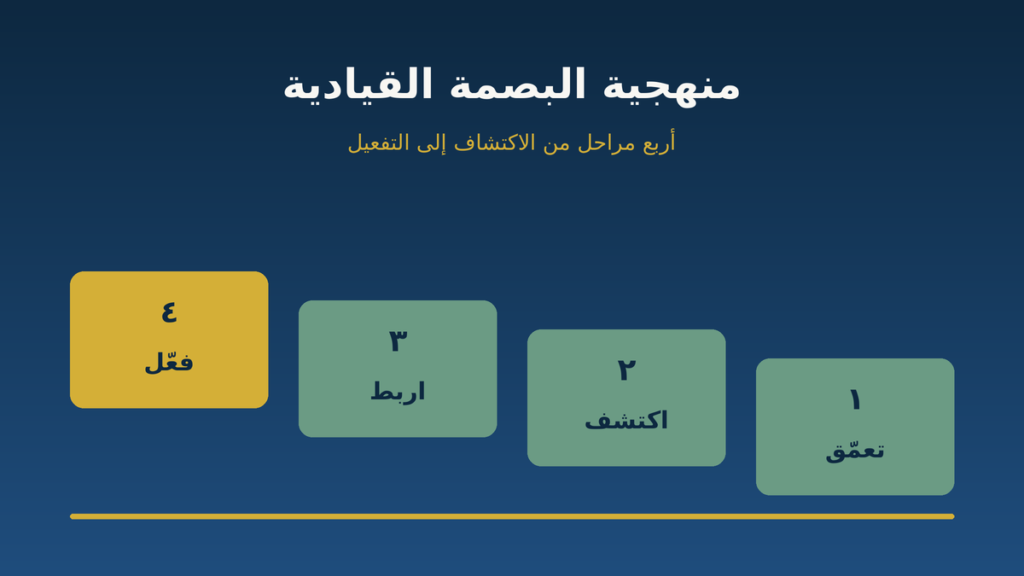
Why four stages?
Because leadership authenticity isn’t a decision made in a single session. A leader suddenly told to “just be yourself” often doesn’t know where to start, having spent years measuring themselves against someone else’s standard. The four stages break the task down: first you understand who you are, then you name what sets you apart, then you translate that into decisions, then you test it in reality. Each stage builds on the one before it, and skipping one is the most common reason leadership-development programs stall.
Stage one: Deepen
The starting point isn’t “what do you want to improve?” but “what actually drives you?” We work across three layers: the values that govern your decisions when no one’s watching, the motivations that pull you toward a particular kind of work, and the formative experiences that shaped how you judge things. The practical question: when did you last feel you were leading in a way that was entirely you? Then we unpack that moment. Output of this stage: a written list of your core values (four to six, no more), and a candid description of what drains you and what energizes you in leadership work.
Stage two: Discover
Here we move from feeling to naming. Many leaders know they’re “good at something” without being able to name it, and what can’t be named can’t be invested in, defended, or built into a team around. We work to surface recurring patterns: what comes easily to you that others find exhausting? What kind of problems do people specifically bring to you? What behavior have you been both rewarded and criticized for at the same time? That last zone — what’s sometimes described as “odd” about you — is often the core of your distinctiveness, not a flaw to hide. Output of this stage: three to five “pillars,” named in your own words, describing what you offer that no one else offers in quite the same way.
Stage three: Connect
The most dangerous gap in leadership development is between awareness and behavior — a leader who knows their values perfectly, then runs a meeting that contradicts every one of them. The connecting stage addresses this: we take what you’ve discovered and translate it into specific decisions in specific situations. In practice, we review your actual week, and ask of every decision: is this an expression of your fingerprint, or of an external expectation? This is where limiting beliefs become clearly visible, and we regard them as testable hypotheses, not facts. Output of this stage: a written leadership plan that ties each of your pillars to a concrete weekly behavior and a marker that tells you whether you’re actually living up to it.
Stage four: Activate
A leadership fingerprint that stays in a notebook has no value. The activation stage is application inside your real environment, with its pressures, politics, and team — not in a training room. We start small and specific: one situation a week where you choose to lead in your own way rather than the expected way, then we review what actually happened, not what you expected to happen. What surprises most clients is that the imagined cost of authenticity is far higher than its real cost; a team, more often than not, responds to clarity and consistency far more than to the familiar pattern. Output of this stage: field evidence that your style actually works, and more room to lead by it without asking permission.
How do you start on your own today?
You don’t need a coach to begin stage one. Set aside one hour, phone away, and write out answers to these four questions: describe three situations where you led in a way that felt entirely like you — what’s the common thread between them? What drains you in your current role despite the fact that you’re good at it? If three people who’ve worked with you were asked what makes you distinct, what exactly would they say? What leadership behavior are you holding back because you think it’s “not appropriate” for your position? That fourth question, specifically, is usually where the fingerprint is hiding.
“The best coaching doesn’t change leaders — it helps them discover and activate what was always there.” — Saad Al-Hamidi, PCC-ICF
Start with a free discovery session to begin your first stage with direct guidance.